Why Most "Free" AI Checkers Fall Short (And Which Ones Don't)
Author:Ashely
Released:December 3, 2025
The internet is full of so-called “free” checkers, all claiming to catch grammar mistakes, plagiarism, or AI-generated content. For writers, students, and educators, it's easy to feel lost or frustrated trying to figure out which ones actually work. Here, we'll break down the free tools that really work and give you a heads-up on their limits so you know what to trust.
The Reality of “Free” Tools
The demand for free AI checkers has exploded as generative AI becomes part of everyday workflows. From SEO specialists trying to avoid penalties to students checking academic integrity, everyone wants something free and accurate. But the “free” label often comes with strings attached: limited word counts, paywalls for meaningful results, or algorithms that miss subtle patterns from advanced models like GPT‑4o.
Across communities (Reddit writing threads, niche forums, and user review sites), a clear pattern pops up: people searching for a “Grammarly AI checker free” often find that while Grammarly is excellent at grammar and clarity, its AI‑detection is either very basic or tucked behind premium paywalls. Conversely, tools like GPTZero and Copyleaks repeatedly get mentioned for specific strengths — albeit with caveats.
Before we dive into the tools themselves, one data point worth noting: in a survey of educators and tech professionals, over 60% said they use at least two different checkers when validating content — because no single free tool catches everything.
Top-Rated Free Tools Comparison
Below are tools you can start using today, with notes on whether they're fully free or freemium (free tier + paid upgrade):
1. GPTZero (Free tier available)
Best for: Quick AI‑generated content estimation
GPTZero estimates the likelihood that text was AI‑generated - which is why it's popular in student and academic communities. On forums like r/Professors and r/AcademicWriting, users say it “gives a helpful first look” but has false positives for highly structured academic or non‑native English text.
Free? Yes, up to a limited word count per scan.
Limitations: Not a plagiarism checker; occasional false flags on creative or technical phrasing.
2. Copyleaks (Freemium)
Best for: Multi‑language plagiarism + AI detection
Copyleaks combines plagiarism scanning with AI detection and even integrates with Google Docs and learning platforms. Users on r/SEO highlight that it catches “clever rephrasing” that simpler tools miss.
Free? Yes, with daily limits.
Limitations: More generous tiers require subscription, and long documents may need batching.
3. ZeroGPT (Free tier available)
Best for: Fast “is this AI?” checks
ZeroGPT offers quick content scans and is often recommended for short emails, social posts, or messaging drafts. According to Threads and Reddit user feedback, its sensitivity can be aggressive, flagging repetitive style as AI even when human‑written.
Free? Yes, with scan limits.
Limitations: Higher sensitivity = more false positives.
4. Grammarly (Free)
Best for: Grammar, clarity, and basic AI cues
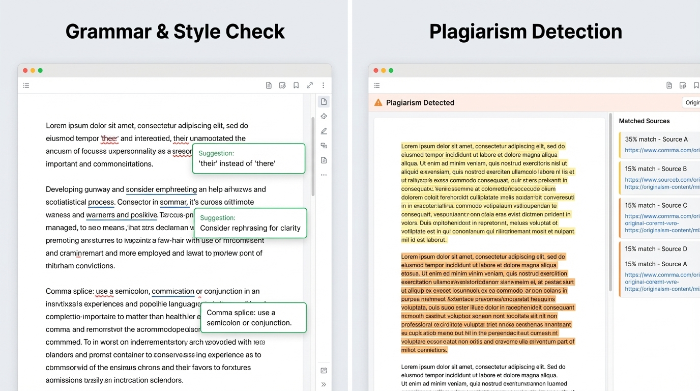
Though not a dedicated AI detector, Grammarly's free tier is extremely reliable at cleaning up mechanical issues — spelling, punctuation, awkward sentences — which improves readability before deeper checks. Many writers use it as a first pass. On writing forums, people note: “Grammarly fixes the basics that trip up other tools.”
Free? Yes (core grammar/style checks).
Limitations: AI‑detection and plagiarism are limited or premium.
5. Winston AI (Freemium)
Best for: Detailed probabilistic AI detection
Winston generates reports that estimate how likely the text was AI‑generated. Users praise its explanation features, where flagged sentences come with context on why they were flagged.
Free? Limited credits; paid plans expand usage.
Limitations: Credits can run out quickly on large texts.
6. QuillBot (Freemium)
Best for: Paraphrase detection + grammar support
QuillBot's plagiarism checker and grammar tools help writers refine or rephrase text while identifying duplicates. Forum users value it as a “second look” after initial grammar cleanup.
Free? Yes (with restrictions).
Limitations: Plagiarism scanning is limited unless upgraded.
7. Paperpal (Free tier)
Best for: Academic writing checks
Paperpal is often touted in research and academic circles for its grammar and structure suggestions tailored to papers, theses, and technical writing. Users praise its contextual feedback, especially for non‑native speakers.
Free? Yes, with premium add‑ons for deeper suggestions.
Limitations: Best suited for academic text; general blog/SEO use is less polished.
The Hard Truth About AI Content Detection
Trying to find a free AI checker that consistently distinguishes human vs. AI writing is fundamentally tricky. Modern models keep improving, producing text that mimics nuance, tone, and context — which makes algorithmic detection a moving target.
Even the best detectors show high rates of false positives on writing that's well‑structured or follows predictable patterns. This isn't an indictment of the tools so much as the task: distinguishing style from origin is inherently fuzzy, especially at no cost.
Expert insight: Linguistics and NLP researchers argue that “there's no reliable technical marker that unequivocally signals AI vs. human text,” which is why professionals treat all automated detection as preliminary, not definitive.
Tips From Real Users (Forums + Community Feedback)
Reddit users on r/Proofreading often recommend running text through at least two tools before concluding — comparing flags helps highlight stylistic issues rather than origin.
Writers on r/AcademicWriting share that “GPTZero tends to mark structured abstracts as AI, so they manually review flagged sections instead of relying on the raw score.
In SEO forums, users point out that “Copyleaks often catches pwhatothers miss,” especially in multi‑language content.
Students note that Grammarly's free grammar cleanup makes AI scans much more accurate — because clean text reduces noise that triggers false flags.
Smart Strategies for Using Free AI Checkers
Run multiple tools: If one tool says “100% human” and another says “80% AI,” you almost certainly need manual review.
Treat detection as a guide: Think of AI & plagiarism scores like a smoke detector — they signal where to look, not a final judgment.
Avoid sensitive data: Never submit proprietary or confidential text to unknown free sites. Stick to reputable tools like the ones above.
Understand limits: Free checkers excel at obvious grammar or duplicated content but struggle with nuanced AI‑style detection.
Take Control of Your Writing
Free AI checkers can be helpful first steps — highlighting obvious grammar issues, potential duplication, or gross patterns. But they're not substitutes for thoughtful review. The most reliable quality control still combines tools with human judgment:
Use Grammarly or QuillBot to tighten clarity and grammar
Run Copyleaks or Paperpal for plagiarism or academic context
Try GPTZero/ZeroGPT/Winston for a sense of AI likelihood, but don't take results as final
The key is to use these tools as checkpoints, not as judges. Improve your writing, verify flagged points thoughtfully, and rely on human reasoning for all important decisions.